
Jan. 8 Major water main break update
The City of Calgary remains in a vulnerable position as continued high water use puts the community at real risk should an emergency arise.
“Calgary’s water system is under significant strain, and while we’ve seen encouraging signs of reduced consumption, we are still operating with very limited capacity to respond to any unexpected events,” says Calgary Emergency Management Agency Chief Susan Henry.
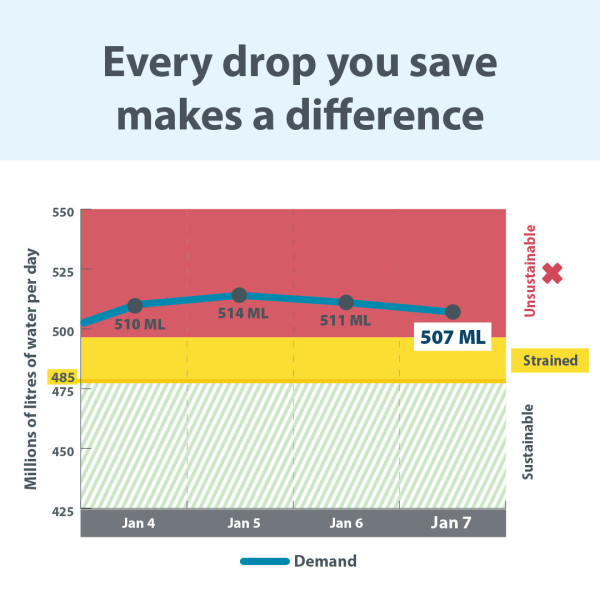
On Wednesday, Jan. 7, Calgarians used 507 million litres (ML) of water, above the target zone of 485 ML.
If every person who relies on our water system saves just 30 litres per day, we will hit our target of 485 million litres and stay in the safe zone.
Saving this much water is simple, you can do this by:
- Flushing toilets only when needed—skipping three flushes saves about 30 liters.
- Every one minute you save in the shower saves up to 8 liters of water.
- Running your dishwasher and washing machines with full loads only.
Across the region, organizations and communities are reducing their non-essential water use by adjusting operations, reusing water where possible and pausing activities like rink flooding or decorative water features.
City recreation centres are also doing their part. Steam rooms are closed, and wave pool and water slide hours have been adjusted to reduce water use.
These steps show how small actions can make a big difference.
CONSTRUCTION PROGRESS
Repair work on the broken pipe is progressing well. The damaged section has been removed, and the new pipe is now in place and welded.
Crews have begun backfilling the area and will then start repairing the road above the pipe once we complete all the critical steps to restore water service.
The mandatory Stage 4 water restrictions will remain in place until the pipe is fully restored and service is back to normal.
RESTORING WATER SERVICE
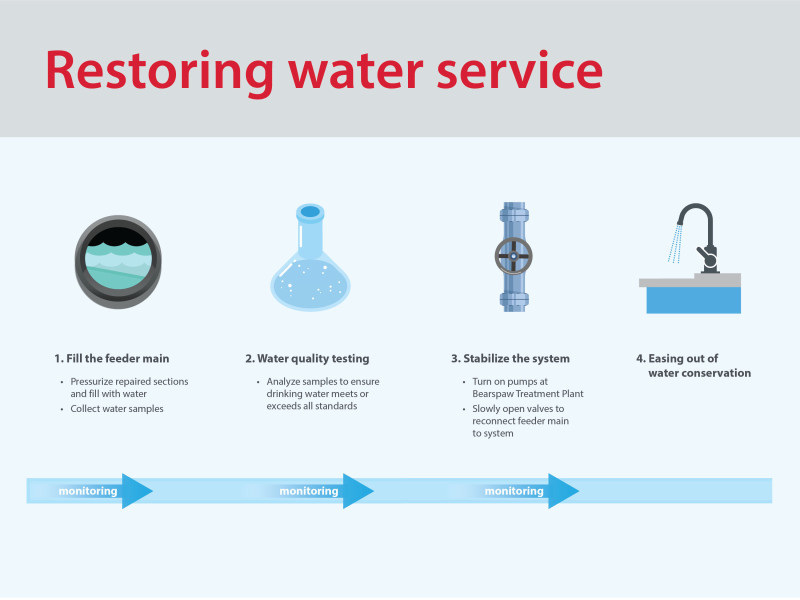
To restore service to the feeder main and stabilize our system, there are four main steps:
- Filling the feeder main
- Water quality testing
- Stabilizing the system
- Easing out of water conservation
A 7-kilometre section of pipe is currently empty and must be refilled. Water will be supplied from the Bearspaw Water Treatment Plant, not the Glenmore Reservoir, to ensure we have enough water to get through to spring runoff.
As the pipe fills, pressure increases, which can stress the pipe and raise the risk of additional breaks. To manage this risk, crews will closely monitor the system using pressure sensors and other tools to watch for any signs of stress or damage.
During this step, Calgarians may notice City workers releasing water through community fire hydrants, this is necessary to help us manage pressure and improve water quality.
Once the feeder main is filled, we will work with Alberta Health Services and Environment and Protected Areas to perform water testing to ensure the water quality meets or exceeds safety and quality standards. This step will take an additional 24 hours to complete.
After water quality is confirmed, we will move to stabilizing the system by activating pumps at the Bearspaw Water Treatment Plant and reconnecting the feeder main to the larger water distribution network.
System stabilization is expected to take about 48 hours and carries the highest risk, as pressure changes can stress pipes and connections. Crews will closely monitor the system and adjust as needed.
We recognize Calgarians are eager to know when restrictions will ease. This will happen gradually as the system stabilizes. More details on timing will be shared as we move through each stage and confirm progress.
MITIGATION STRATEGIES
This is delicate work, and setbacks are possible at each step. There is no guarantee that the pipe will not break again and we need to be ready. We are taking extra precautions to prepare and protect the community.
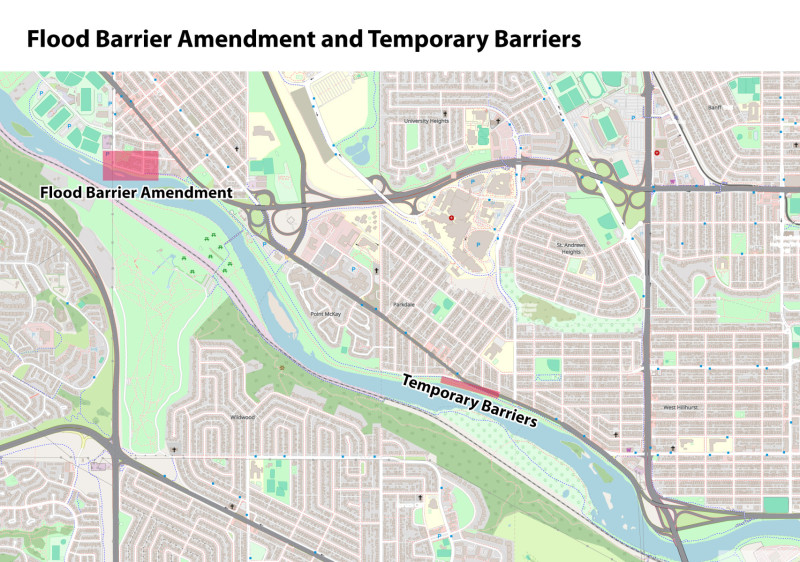
As a safety measure, crews will temporarily adjust nearby flood protection and drainage so that, if another break were to occur, water can flow safely to the Bow River instead of pooling in neighbourhoods. This includes:
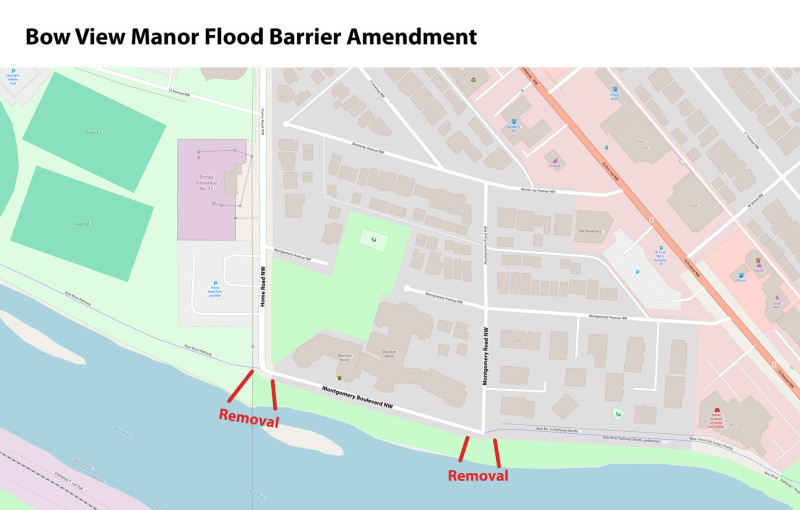
- Removing small sections of the flood barrier along Montgomery Boulevard N.W. across from Bow View Manor.
- Installing temporary barriers near Parkdale Boulevard N.W. on a 400 metre stretch between 33 and 30 street N.W.
- Clearing catch basins, opening outflows to the river, and changing manhole covers throughout the area to make sure that the ones we have in place allow water to drain as quickly as possible.
- Having plans in place to rapidly deploy temporary pumps to clear water away from low lying areas, if needed.
This work will begin immediately while we continue to return the pipe to service.
ROADS AND MOBILITY
Reminder that a single eastbound lane on 16 Avenue N.W. east of Sarcee Trail N.W. has reopened. Access to eastbound 16 Avenue N.W. from Sarcee Trail has also reopened. Westbound traffic along 16 Avenue N.W. between 49 Street and Sarcee Trail N.W. remains closed. Speed reductions are in place throughout the construction area.
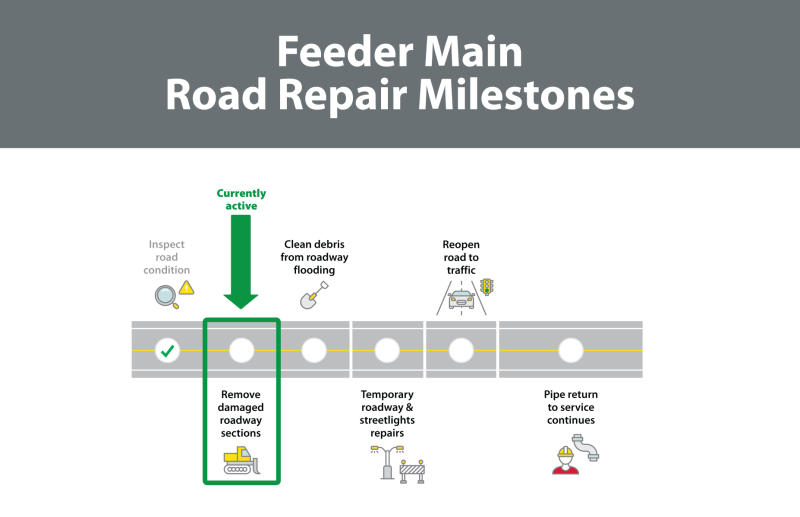
An evaluation of the remaining roadway surrounding the excavation site of the pipe was completed, and road reconstruction has begun, by removing asphalt that was damaged during the watermain break.
For the latest information about road closures and detours, please go to: https://www.calgary.ca/roads/conditions/traffic.html
To view the daily water usage dashboard, visit calgary.ca/watermainbreak
More updates will be shared as information becomes available.