
Update August 9: Critical water main break affecting city-wide water usage
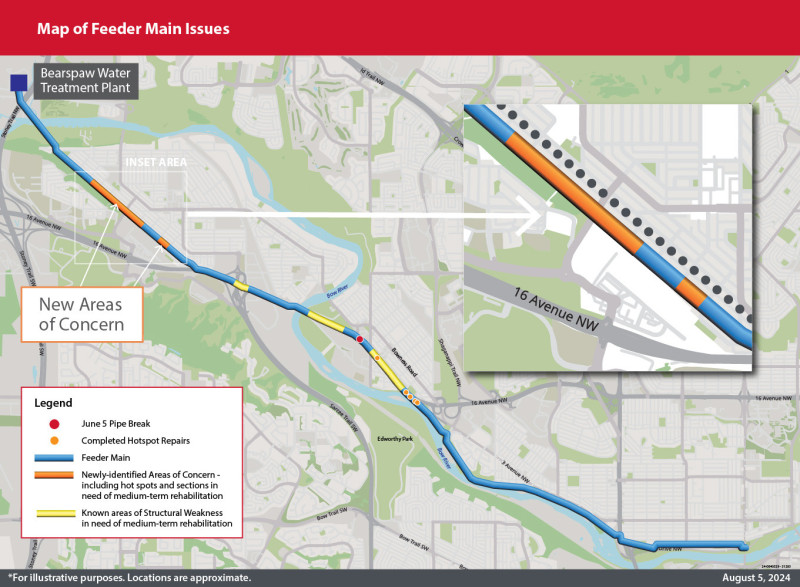
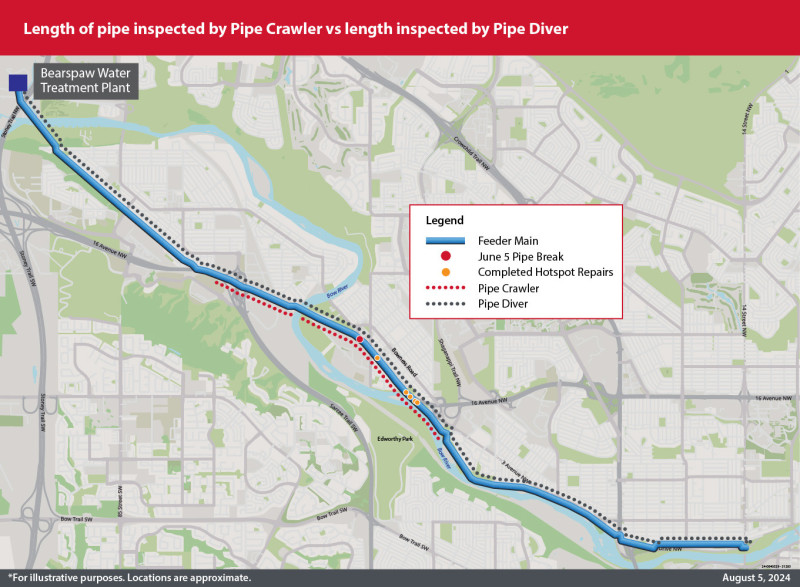
As part of our plan in repairing the original site of the feeder main break, we employed a device called a PipeDiver in early July to learn more about the pipe’s condition. The PipeDiver inspected 10.4 kilometers of the Bearspaw South Feeder Main and allowed us to reach areas of the pipe we hadn’t previously been able to access.
On Wednesday, we announced that the results of our PipeDiver inspection, combined with previous testing and ongoing acoustic monitoring, revealed approximately 16 sections of pipe that require urgent repair to prevent the risk of another break, including some new hot spots. These repairs are critical to ensuring that Calgary's water supply is maintained through the winter.
To facilitate these urgent repairs, we will need to shut down the Bearspaw South Feeder Main and temporarily stop the flow of water through it from August 26 to the end of September. During this time, we will be returning to Stage 4 Outdoor Water Restrictions and asking Calgarians and businesses to limit their non-essential indoor water use to reduce the strain on our water supply.
Until repairs start on August 26, Calgary will remain under Stage 1 Outdoor Water Restrictions.
What is new
We understand that the ongoing repair work and the resulting water restrictions will have some significant impacts on Calgarians and especially on certain industries. We've already started reaching out to residents and businesses in the areas most affected, particularly along 33 Avenue N.W., 16 Avenue N.W. and Parkdale Boulevard. Yesterday, we knocked on more than 100 doors of residents and we talked with 45 businesses to share what we know about the upcoming repair work.
We've also been in communication with regional partners, industries and large customers to clarify what the Stage 4 Outdoor Water Restrictions mean for them and how we are supporting them.
We still have more groups to connect with and are committed to sharing details about specific repair locations, road closures or other impacts as our plans evolve. We’re sharing what we know so far to give Calgarians as much notice as possible and involve them in the planning process.
Repair work
We’ve received a lot of questions about why we need to turn off the water if we're reinforcing the pipe versus cutting it. While the pipe is in service, it is moving significant volumes of water, even at the current reduced flow. We need to depressurize the pipe before we start any pipe excavations regardless of repair method. If the pipe is exposed while pressurized, there is a high risk of a break, which poses a serious safety risk for our crews—something we cannot risk.
Rehabilitation planning
We’ve also heard concerns around our planning for this pipe. We have a comprehensive plan for all our water infrastructure, including this pipe, and regular inspections and maintenance have been performed as recently as spring 2024. We replaced the air valves and installed an acoustic monitoring device, completed routine field checks on valve chambers and performed several test shutdowns in the winter of 2023 and spring 2024 in preparation for a full condition assessment this winter.
Despite recent issues, 98 per cent of our water distribution system is rated as being in “good” or “very good” physical condition. We are unable to physically inspect all existing infrastructure yearly, so physical condition is based on a combination of factors including operational knowledge and experience of known issues.
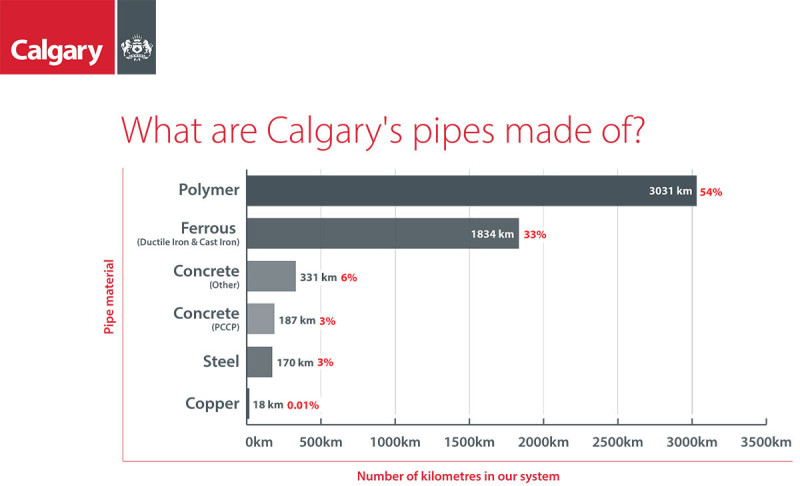
The pipe is 10.4 kilometers long and is the only one of its kind in our system, although we have 187 kilometers of similar pipes. Our entire water distribution system has over 5,000 kilometers of pipes, with only 3% made of Prestressed Concrete Cylindrical Pipe. Most of our system uses polymer pipes, which are more common.
During the original break, we were able to learn more about the pipe’s physical condition once it was excavated. This has prompted us to develop short, medium and long-term rehabilitation plans in consultation with a private engineering consultant.
The short-term rehabilitation plans are currently being executed for the urgent repairs. The medium and long-term plans are still being developed using data from the PipeDiver, electromagnetic testing and through visual inspections from when the pipe was excavated. We are considering options like replacing individual segments of pipe, externally reinforcing segments of pipe, lining the existing pipe or installing a new pipe nearby. Work continues on these plans and we will share more information when it is available.
Outside of the rehabilitation work on the Bearspaw South Feeder Main, we are working on plans to increase redundancy in our water distribution system. This includes developing the North Feeder Main and the South Feeder Main. We are currently in the design phase of the North Feeder Main and plan to start construction next year. Both projects will be delivered in phases over eight years.
Redundancy is an important next step in the long-term rehabilitation of the feeder main as it allows us to take the existing feeder main out of service while limiting the impacts to Calgarians and our customers. It also ensures we continue to provide clean, safe drinking water to Calgarians while meeting the demands of our growing city.
Next steps
We are committed to getting the necessary repairs completed and will be working 24 hours a day, seven days a week to minimize the impact on Calgarians, businesses and our regional partners. We will provide regular updates as we approach the start of construction and throughout the process. Thank you for your patience and support as we work to keep Calgary’s water supply safe and reliable.