
Largest missing-person response in CPS history leads to recommendations for future critical incidents
Today, we are publicly releasing the key themes from our operational and investigative review of the search for 11-year-old Parker.
The review was undertaken internally to identify lessons learned, recognize what worked well and recommend practical improvements for future missing-person investigations, major searches and other prolonged critical incidents. It does not assess the performance of individual employees or partners, nor does it reinvestigate the circumstances of Parker's disappearance.
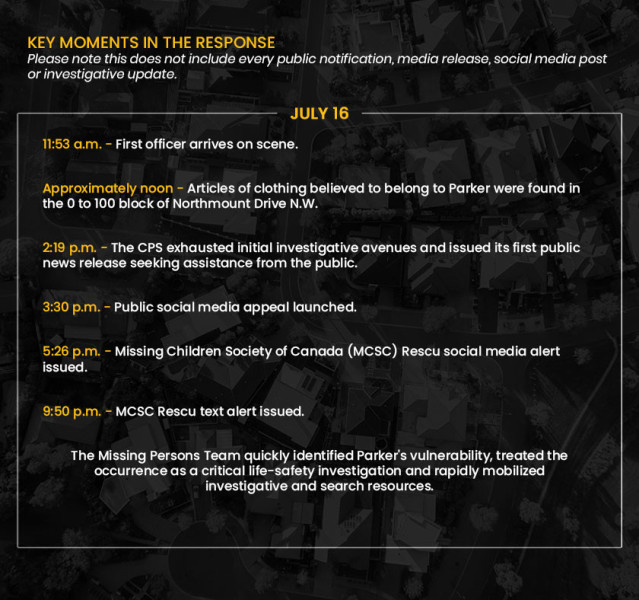
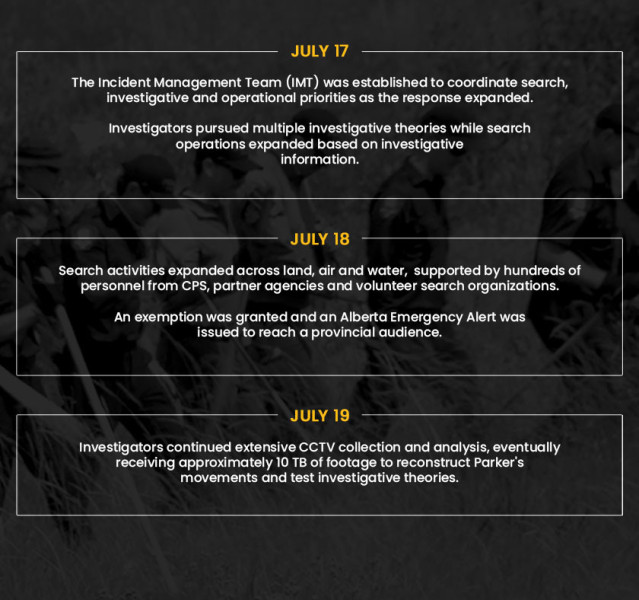
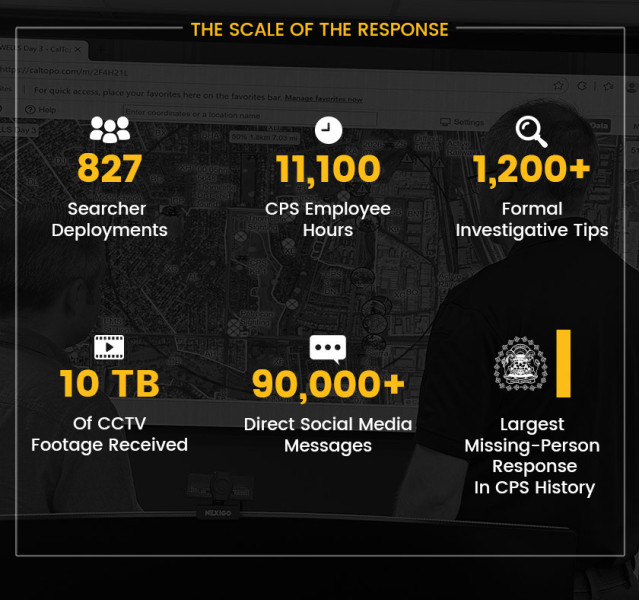
The search for Parker became the largest missing-person response in CPS history, involving a sustained, multi-agency operation, extensive community participation and significant investigative, search, technological and communications resources. The review found that members, partner agencies, volunteers and community members demonstrated extraordinary commitment throughout the response while also identifying opportunities to strengthen organizational systems and processes for future incidents.
Like so many Calgarians, our members were deeply affected by Parker's disappearance and remained committed to finding him and supporting his family. The review recognizes the efforts of our members, partners and the community throughout this response. It also challenges us to learn from the experience and identify ways we can strengthen future responses to major missing-person investigations and other prolonged critical incidents.

The review found a number of significant strengths across the response, including:
- Investigation-led search management
- Public awareness and community engagement
- Technology and digital evidence capabilities
- Strong partnerships and interagency collaboration
- The professionalism, compassion and adaptability demonstrated by members and partners throughout the response
The review also identified opportunities to strengthen organizational systems related to:
- Scalable resourcing and operational sustainability
- Command integration and incident management
- Tip, task and canvass management
- Public alerting and partnership frameworks
- Technology readiness and scalability
- Member wellness and operational resilience
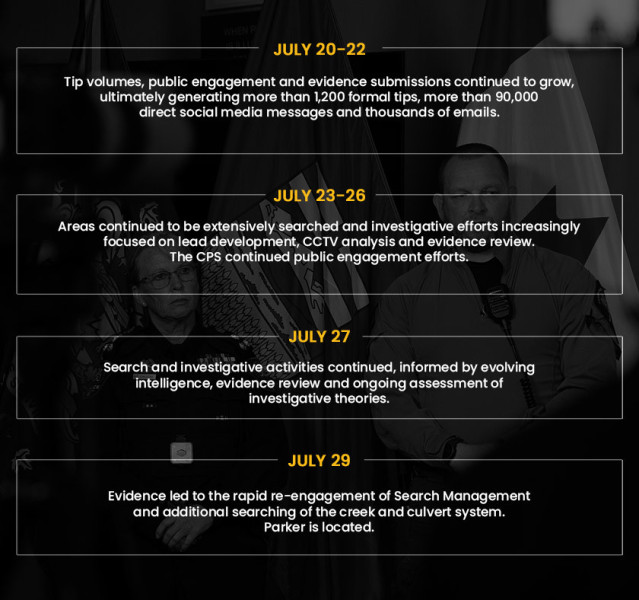
One of the key findings involved the unprecedented volume of information received during the investigation. The response generated approximately 1,000 formal investigative tips, more than 90,000 direct social media messages, thousands of emails and approximately 10 terabytes of CCTV footage. The review found that while this information provided significant investigative value, existing systems were not designed to easily manage information at that scale during a prolonged critical incident.
The review found that many successes were achieved because people stepped forward, adapted and remained committed under extraordinary pressure. At the same time, we identified opportunities to build stronger systems around our people so future responses don't depend as heavily on extraordinary individual effort. The goal is to improve how we support members, manage information and coordinate resources during large-scale incidents.
The review found that additional capacity and stronger organizational systems would have helped the CPS receive, assess, assign and track the extraordinary volume of information more efficiently. It does not conclude that different resources, systems or processes would have changed the outcome. Rather, it identifies opportunities to improve future responses through better coordination, continuity, information management and operational planning.
The review also acknowledges the provincial review on alerting is underway and the recent findings released by The City related to the initial 9-1-1 response. The CPS recognizes and respects The City's review process and responsibilities. The CPS review examined the police response, including investigations, search operations, public engagement, communications, technology and partnerships. It identifies Calgary 9-1-1 as an essential partner in future policy development, training, information sharing, tip management and major incident planning.
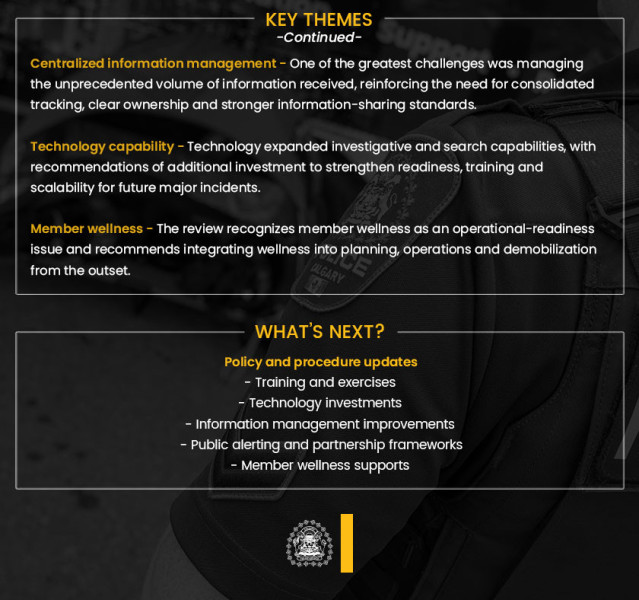
Formal recommendations were identified across investigations, search management, incident command, strategic communications, partnerships and public alerting, tip management, technology and member wellness. These recommendations will inform future policy development, training, exercises, technology investments and operational planning.
We recognize that renewed discussion of this case may be difficult for Parker's family, members involved in the response and many others in our community. The release of these key themes is intended to support transparency, accountability and continuous improvement while honouring the collective effort invested in the search for Parker.
The Calgary Police Service Victim Assistance Support Team (VAST) is a free service that provides support, resources and information to victims of crime and tragedy. For anyone who needs support, VAST can be reached at 403-428-8398 or toll-free at 1-888-327-7828. More information is available at https://www.calgary.ca/cps/community-programs-and-resources/victims-of-crime/victim-assistance-support-team.html
Key themes from the review:
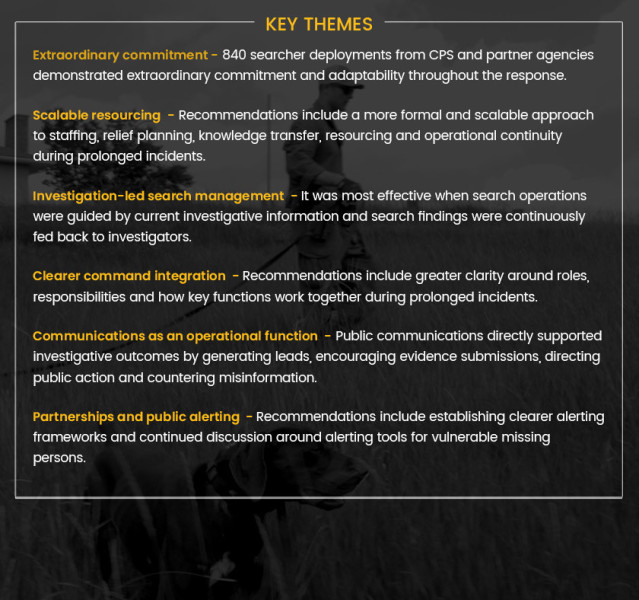
Extraordinary commitment from members and partners
Members worked prolonged hours, volunteered outside their regular duties and remained focused on locating Parker and supporting his family. The review found that investigators, search managers, operational commanders, support staff and partners demonstrated extraordinary professionalism and determination. More than 800 searcher deployments were contributed during the response, with personnel from across the CPS and numerous partner agencies stepping in to support investigative, search, operational and community engagement efforts. The review repeatedly notes that many successes were achieved because of the commitment and adaptability of people across the organization.
Scalable resourcing and operational sustainability
The response tested the CPS' ability to sustain staffing, preserve knowledge, relieve personnel and coordinate resources over an extended period. As the investigation grew more complex, maintaining continuity became increasingly important. The review found that key personnel developed extensive knowledge that was difficult to transfer between shifts or personnel rotations and that many support functions were scaled up through individual initiative rather than formal surge plans. The review recommends a more formal and scalable approach to investigative staffing, relief planning, knowledge transfer, resource generation and operational continuity during prolonged critical incidents.
Investigation-led search management
The review found that search operations were most effective when guided by current investigative information and when search findings were continuously fed back into the investigation. Search managers, investigators, geomatics specialists and partner agencies worked together to adjust priorities as new information emerged, rather than relying solely on traditional search practices. The review reinforces the importance of maintaining a close connection between investigative and search functions and recommends updates to policy, training, documentation and governance to align with current standards and emerging best practices.
Clearer command integration
As the response evolved, additional planning, logistics and resource coordination functions were introduced to support the investigation and search effort. The review found that these functions provided significant value, but that roles, responsibilities and activation thresholds were not always clearly understood across all groups involved in the response. It recommends greater clarity around how investigators, search management, the Real Time Operations Centre, Major Events and Emergency Management and incident-management functions work together during prolonged critical incidents, supported by policy updates, training and exercises.
Communications as an operational function
The review found that communications became much more than a public information function. Media engagement, public appeals, social media content, community outreach and family communications directly influenced investigative outcomes by generating leads, encouraging evidence submissions, directing public action and countering misinformation. Communications professionals also managed significant volumes of public engagement throughout the response. As a result, the review recommends embedding Strategic Communications further within major-incident command structures and ensuring communications capacity is considered when planning for large-scale public engagement campaigns.
Partnerships and public alerting
The response relied heavily on partnerships with government agencies, search-and-rescue organizations, community partners, the Missing Children Society of Canada and members of the public. Public awareness efforts, including the Alberta Emergency Alert, MCSC Rescu platform, extensive media coverage and social media outreach, helped expand awareness of Parker's disappearance far beyond Calgary. The review found these partnerships and alerting tools generated significant public participation and investigative information, while also creating substantial operational demands. It recommends clearer alerting frameworks, a more formalized relationship with MCSC and continued CPS involvement in discussions around future alerting tools for vulnerable missing persons.
Centralized tip, task and canvass management
The review found that one of the greatest challenges was not generating information, but managing the unprecedented volume of information received. Approximately 1,000 formal investigative tips, more than 90,000 direct social media messages, thousands of emails and significant volumes of digital evidence were received through multiple intake channels. Investigators often had to reconcile duplicate information, determine ownership and verify follow-up across separate systems. The review recommends a centralized tip-management system, consolidated canvass tracking, clear ownership and stronger information-sharing standards to improve coordination and reduce duplication during future major incidents.
Technology as a core operational capability
Technology played a critical role throughout the response and significantly expanded what was operationally possible. Mapping tools, video analytics software, drones, digital evidence platforms and public evidence-submission tools supported evidence collection, information sharing, search coordination and investigative decision-making. However, the review found that supporting infrastructure, server capacity, licensing models, technical support and trained-user availability were strained by the scale of demand. It recommends additional investment in technology readiness, training and scalability to support future major incidents.
Member wellness
The review recognizes member wellness as an operational-readiness issue rather than solely an individual responsibility. The sustained nature of the response exposed members to long hours, high workloads, emotionally difficult circumstances and intense public scrutiny. While wellness supports were made available, the review found that future major incidents would benefit from wellness being formally integrated into planning, operations and demobilization processes from the outset. Recommendations include proactive outreach, clear wellness activation processes and stronger coordination between operational and wellness teams during prolonged critical incidents.
Statement from Parker’s Family
Our family would like to express our sincere thanks to everyone who helped search for Parker. We are profoundly grateful to the first responders, search‑and‑rescue teams, volunteers, partner organizations, community members, and the countless individuals who gave their time, energy, and support in the hope of bringing Parker home. The overwhelming kindness and dedication shown by so many during the most heartbreaking time of our lives is something we will never forget.
We also want to thank the organizations that have closely reviewed what happened and assessed the response. We appreciate the thoroughness of the evaluation and the care taken to walk us through its findings. While nothing can change what our family has endured, we are grateful for the commitment to learning from this tragedy and identifying ways to strengthen future responses for other families.
As we continue to grieve the loss of Parker, we respectfully ask for privacy and understanding. We are navigating an unimaginable loss, and we appreciate our space being respected as we work toward healing. We remain deeply thankful for the compassion, support, and care shown to our family and to Parker throughout this journey.
In a time of unimaginable fear and uncertainty, the response from everyone involved truly reflected the very best in people. We take great comfort in knowing that Parker’s life touched so many, and that his memory is helping shape meaningful changes.